
Achieving exact hole dimensions and exceptional surface finishes often requires more than standard drilling. The boring machining process is a precision secondary operation used to refine, enlarge, and align pre-existing holes in metal and plastic components.
This article covers how the boring process works, key machine types, common applications, and practical optimisation strategies, with direct comparisons to drilling, turning, and reaming.
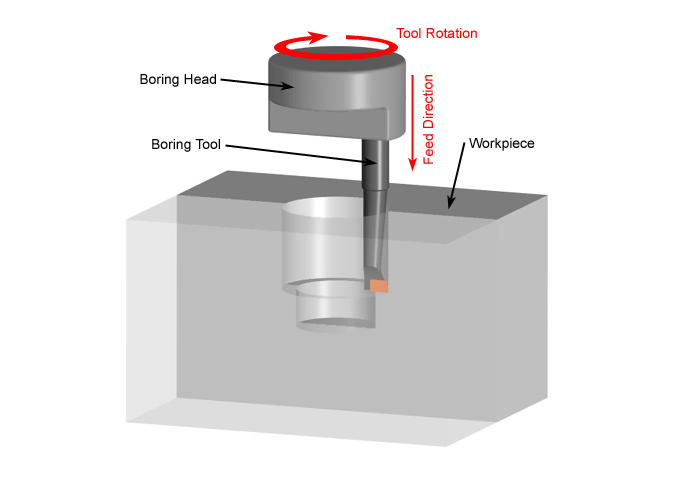 Boring machining is a subtractive precision process used to enlarge, straighten, and refine pre-existing holes in metal and plastic workpieces. It uses a specialised single-point cutting tool or boring head to correct, expand, and finish a hole that has already been drilled, cast, or forged. Unlike drilling, which creates a hole from solid material, boring is an internal diameter (ID) finishing process.
Boring is used when tight tolerances and smooth surface finishes are required. The boring machining process serves three core functions:
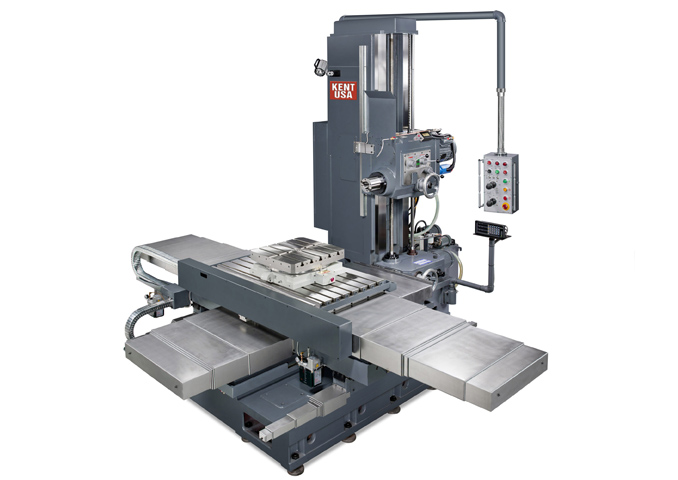 A horizontal boring machine has a horizontally oriented spindle. The boring bar moves horizontally, which suits large parts and deep holes where tool deflection must be minimised. Besides boring, these machines can also perform drilling, milling, and reaming.
Horizontal boring machines are divided into two main configurations:
What Is Boring Machining?
Boring machining is a subtractive precision process used to enlarge, straighten, and refine pre-existing holes in metal and plastic workpieces. It uses a specialised single-point cutting tool or boring head to correct, expand, and finish a hole that has already been drilled, cast, or forged. Unlike drilling, which creates a hole from solid material, boring is an internal diameter (ID) finishing process.
Boring is used when tight tolerances and smooth surface finishes are required. The boring machining process serves three core functions:
- Enlarging to exact dimensions: Expands pre-existing holes to target diameters with tight tolerances, often down to ±0.0005 inches, with high-quality surface finishes.
- Correcting concentricity and alignment: Fixes location errors so the hole centreline is concentric with external diameters or neighbouring features.
- Straightening bore axis: Eliminates hole wander from drilling, casting, or forging, producing a straight, true bore.
How Does Boring Machining Work?
https://youtu.be/i1bhiX1ldnE?si=KURexsfFd0pf_04l
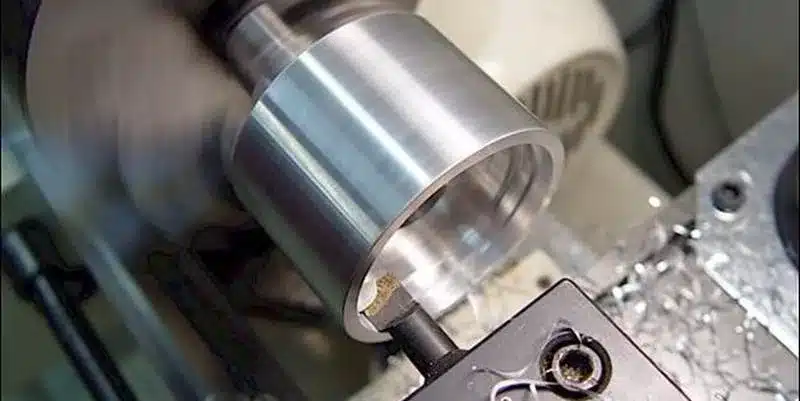
The boring machining process uses a single-point cutting insert mounted on a boring bar to remove material from the inner diameter of a workpiece.#1. On a lathe:
The workpiece rotates while the stationary boring bar feeds into the hole.#2. On a milling machine or boring mill:
The workpiece remains stationary while the spindle rotates the boring tool into the bore.#3. Prepare and mount the tool:
The machinist selects a boring bar based on the required hole size and hole depth, limits tool overhang for stability, and ensures proper alignment with the bore during setup.#4. Set cutting parameters:
Spindle speed, feed rate, and depth of cut are configured based on the workpiece material and required tolerance.#5. Rough boring:
The first pass removes the bulk of the material, correcting runout or casting defects.#6. Finish boring:
A light cut at lower feed rates delivers the final dimensions and surface quality.#7. Verify hole geometry:
The boring tool corrects out-of-roundness, taper, and axial drift, producing a straight, concentric bore. For large components with multiple bores on a common axis, line boring aligns all bores in a single setup. When boring blind holes, allow adequate chip clearance at the bottom and set precise depth stop points to prevent the cutting tool from contacting the workpiece base.What Are the Types of Boring Machines?
Boring machines are categorised by spindle orientation and machining capability. Below are the most common types.Horizontal boring machines
A horizontal boring machine has a horizontally oriented spindle. The boring bar moves horizontally, which suits large parts and deep holes where tool deflection must be minimised. Besides boring, these machines can also perform drilling, milling, and reaming.
Horizontal boring machines are divided into two main configurations:
- Table type: The most common variant. An adjustable table positions the workpiece for multi-sided machining. Table type machines are versatile and widely used in automotive, aerospace, and general manufacturing.
- Floor type: Built without a machine table. The workpiece is secured on T-slotted floor plates. Floor type machines handle massive components such as ship hulls and heavy construction frames. They are often equipped for line boring to maintain alignment across multiple inline bores.
Vertical Boring Machines
A vertical boring machine has a vertically aligned spindle. The workpiece is clamped horizontally onto a rotating turntable. This layout provides stable support for heavy, large-diameter components that are difficult to clamp on a horizontal spindle.
In operation, the tool moves along the vertical boring axis while the workpiece remains supported on the table. The vertical orientation reduces vibration, tool deflection, and chatter on large-diameter bores.Precision Boring Machines
Precision boring machines are designed for tight tolerances and high-quality surface finishes. They feature rigid high-speed spindles, precise feed rate controls, and digital readout or CNC integration. Available in both horizontal and vertical layouts, precision boring machines are common in the aerospace, automotive, and medical device sectors. Micro boring is a specialised subset of precision boring used for very small internal diameters (under 1 mm) in electronics and medical implant components. The precision barrel boring machine, an early form of precision boring equipment, played a key role in the development of modern high-accuracy boring technology.Applications of Boring Machining
The boring machining process is used across a wide range of industries where precise internal diameters, tight tolerances, and high-quality surface finishes are required.- Automotive: Sizing engine cylinders, machining main bearing bores, camshaft housings, and transmission cases. CNC boring is standard for high-volume engine block production.
- Aerospace: Creating exact tolerances for turbine casings, landing gear parts, and actuator fluid control ports.
- Oil and Gas: Finishing thick-walled pipe interiors, high-load valve bodies, and industrial pump housings.
- Heavy Equipment: Line boring aligned holes in large construction frames, cranes, and structural gearboxes.
- Hydraulics and Fluid Power: Creating smooth, leak-free interior walls for hydraulic and pneumatic cylinders.
- Medical Devices: Precision boring of surgical instrument housings and implant components where tight tolerances and surface finish are critical.
- General Manufacturing: Processing decorative holes for jewellery, furniture pieces, and consumer products where appearance matters.
Advantages of Boring Machining