
Advantages
Overmolding combines a substrate and a second material in one component. It can add grip, cushioning or a sealing feature while reducing separate part assembly.
Review the base component, molded layer and intended grip, cushioning or sealing function with Aria.


















A soft layer needs to do more than look attached. Aria’s engineering review considers the selected material pair, joint geometry and the function of the finished component. For a grip, that means the surfaces a user touches; for a seal, it means the mating interface and the test you need the component to pass.
We discuss the mold and manufacturing approach with the part requirements, including exposed edges and retention features. Material names alone do not establish a suitable bond, so the selected grades and the agreed sample checks matter more than a broad promise that any two materials can be combined.
Two or more injection stages combine materials or colors in one component. Two-shot (2K) molding is a two-stage route. Material bonding, tool design and handling must be reviewed together.
A compatible elastomer can add a soft contact surface to a rigid plastic substrate. Select the grade for the substrate and review exposed edges where peeling could begin.
Two plastics can combine color, feel or function within one component. Compatibility and molding temperature must suit the substrate; geometry may also provide mechanical retention.
An elastomer layer can provide grip or cushioning around a metal component. Surface preparation and retention geometry require review for the selected metal and elastomer.
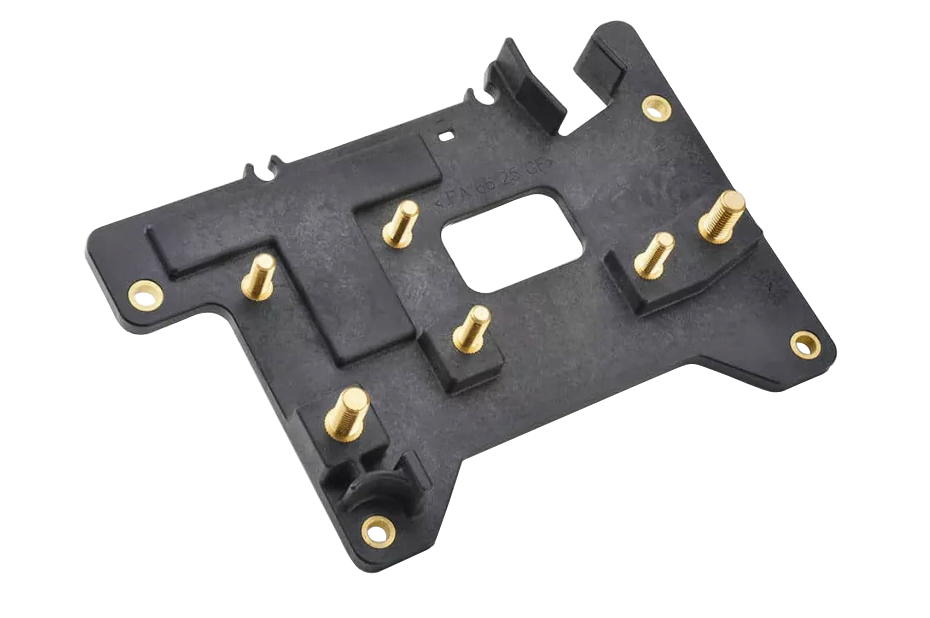
A rigid plastic can be molded around metal features to combine insulation, shape or assembly functions. Define the exposed metal areas and the method of retaining the plastic.
Plastic over plastic, elastomer over plastic, plastic over metal and elastomer over metal; two-shot / 2K tooling. Material pairing requires review.
Overmolding combines a substrate and a second material in one component. It can add grip, cushioning or a sealing feature while reducing separate part assembly.
Overmolding adds a second material to a rigid component for grip, cushioning or a sealing feature. The material pairing and the shape of the joint determine how the layers stay together.
Make the rigid component that will support the molded layer. Its dimensions, material and surface condition must suit the agreed material pairing.
The tool defines the added layer and holds the base component in position. Review layer thickness, exposed edges and the surfaces that must remain uncovered.
Place the base component in the tool and inject the selected material around it to form the required grip, cushion or other feature.
Allow the molded layer to cool, then remove the combined component from the tool.
Bonding depends on the exact grades and surface preparation. Review interlocks and exposed edges, then evaluate adhesion on representative samples.
For compressed elastomer features, consider recovery after loading as well as initial softness. Define the working gap and the test conditions for a seal or cushion.
Material stiffness and section geometry both influence bending. Evaluate the assembled part where the design must flex or provide a soft contact surface.
Grip depends on the material pair and surface condition, including wet or dry use. Evaluate texture and material together for the intended handling conditions.
Hardness describes resistance to indentation. Contact geometry and layer thickness also affect how a grip feels in use.
Layer thickness affects feel, flow and cooling. Review transitions and the support offered by the substrate, especially around thin edges.
Use grade-specific tensile strength and elongation data when selecting the molded layer. Validate the component under the loading and environmental conditions of the application.
The primary difference between them is that, in overmolding, the plastic material is injected directly onto a molded part or assembly; in insert molding, the plastic is first injected into a cavity and then the finished piece is inserted into another injection-molded part.
Overmolding is a process where two or more different materials are molded together to create a single product. In the case of plastic overmolding, one of the materials is typically a plastic. The other material can be another plastic, metal, rubber, or even glass.
Overmolding can reduce production costs. While standard injection molding can combine multiple parts into a single multi-cavity mold, secondary molding can produce individual parts made of different materials without assembly. Mold production is more complex, but it eliminates the repetitive cost of assembling thousands of parts. Get Your Free Quote About Overmolding parts Today. Get Overmolding Quotes Online All information and uploads are secure and confidential.
Upload your CAD files and tell us the material and quantity you need.
Talk to an engineer