

















Specify the features requiring this tolerance.
CNC turning
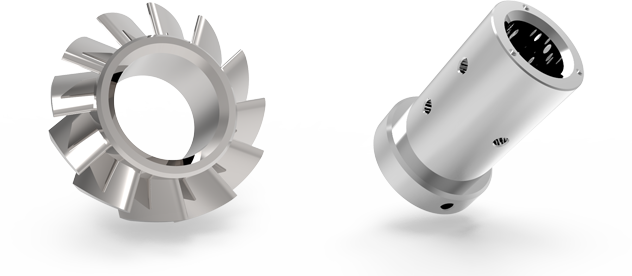
Shafts, sleeves and threaded parts reviewed for the fits, reference axes and mating features your assembly needs.
Plan the fit around the complete assembly
A shaft that measures correctly still needs to fit and run correctly in its assembly. Aria reviews the drawing’s mating diameters, shoulders, bores and reference axes with you, then uses the agreed requirements for manufacture and inspection. This gives the team a clear basis for discussing a bearing fit or a feature that needs closer control.
If the same part needs flats or off-axis holes, we can discuss the milling work alongside turning. Our sample approval policy also covers CNC orders that meet the stated quantity conditions, so the production decision can follow your evaluation of the samples.
Capabilities
Confirm the drawing, material, geometry and inspection requirements during quotation.
Subject to setup and material review.
Cylindrical Turning
It is a process that reduces the diameter of the workpiece uniformly in order to prevent any variation in the cutting diameter.
Boring
A single-point tool is fed linearly, parallel to the axis of rotation, on the inside diameter of an existing hole in the part.
Threading
Threading is a type of CNC turning. It helps in making grooves that can make the workpiece to be easily screwed into other objects.
Grooving
Grooving is a type of CNC turning process in which a narrow cavity is formed by pressing a shaped tool into the workpiece.
CNC turning process ranges
| Parameter | Range | Conditions |
|---|---|---|
| Maximum part size | 200 × 500 mm | Confirm the drawing, material, geometry and inspection requirements during quotation. |
| Minimum part size | 2 × 2 × 2 mm | Confirm the drawing, material, geometry and inspection requirements during quotation. |
| Minimum wall | 0.5 mm | Confirm the drawing, material, geometry and inspection requirements during quotation. |
| Precision feature capability | ±0.005 mm | Specify the features requiring this tolerance. |
| As-machined roughness | Ra 0.8 μm or better | Confirm the drawing, material, geometry and inspection requirements during quotation. |
| Minimum quantity | 1 part | Subject to setup and material review. |
| Fastest delivery | 3 days | Confirm the project schedule in the quotation. |
How Aria supports your project
Clear answers about your order
Discuss drawing changes, finishes and open questions with the engineering team.
Parts made to your design
Custom parts based on your geometry, material and required quantity.
Prototype and repeat orders
Order parts for your next build and discuss quantities for future production.
Understand what affects the price
See how material, tooling and order quantity affect the cost of your parts.
Applications
Shafts, sleeves and threaded parts
CNC turning suits shafts, sleeves, bushings and threaded components. Mark bearing fits, concentric features and mating shoulders on the drawing so they can be reviewed together.
Manufacturing process
01
Secure the stock
Hold the stock in a chuck or collet so it can rotate during machining.
02
Select the cutting tools
Choose tooling for the material, diameters, bores and other required features.
03
Plan the turning sequence
Program the tool movements, speed and feed for the dimensions shown on the drawing.
04
Turn the part
Rotate the stock and remove material to form the required profile.
05
Finish the machined surfaces
Make the finishing cuts needed for the specified surface condition.
06
Inspect the finished part
Check the finished part against the agreed dimensions and inspection requirements.
Design considerations
Select a metal grade for the part’s loads, corrosion exposure and subsequent finishing.
Plastic turned components
Plastic stock can be turned into spacers, sleeves and other rotational components. Grade selection and part stiffness matter when machining thin walls or tight mating fits.
Turned fits and runout
Define the bearing or mating fit and the reference axis for rotating features. Diameter size alone does not describe the relationship between an outside surface, bore and shoulder.
Turning operations
Facing, straight and taper turning, boring, grooving and threading create different features on rotational parts. Flats and off-axis holes may require milling or another secondary operation.
Frequently asked questions
What is CNC machining?+
A: CNC machining is a wide-ranging manufacturing category involving multiple computer-managed processes. The objective is to remove enough raw material from a piece to achieve a state of near completion.
What is the difference between the subtractive and additive manufacturing processes?+
A: CNC machining is a subtractive manufacturing process. When the material is added instead of removed, it’s called an additive manufacturing process. Examples of subtractive CNC machining include specialized applications such as CNC milling services, turning, surface grinding, and EDM. An example of additive CNC machining is 3D printing.
What kind of finish does CNC machining have?+
A: The spinning motion from the CNC machine’s cutter will leave visible tool marks. Although they stand ready for immediate service, they can be further refined with anodizing, painting, polishing, and plating. Aria supply online cnc machining service, Get Your Free Quote About cnc machined parts Today. Get CNC Turning Quotes Online All information and uploads are secure and confidential.
Why choose CNC machined parts by Aria?+
A: Aria is a professional CNC machining manufacturer in China, The reliability and precision of high-tech tools powered by sophisticated software programs give CNC machining the ability to quickly generate prototypes and complicated end-use parts having exceptionally tight tolerances. with low cnc machining costs from Chinese.
Start a project
Get a quote for your parts
Upload your CAD files and tell us the material and quantity you need.
Talk to an engineer