
Advantages
High conductivity, ductility and corrosion resistance, with useful brazing, welding and plating behavior. C11000 is referenced to 100% IACS conductivity.
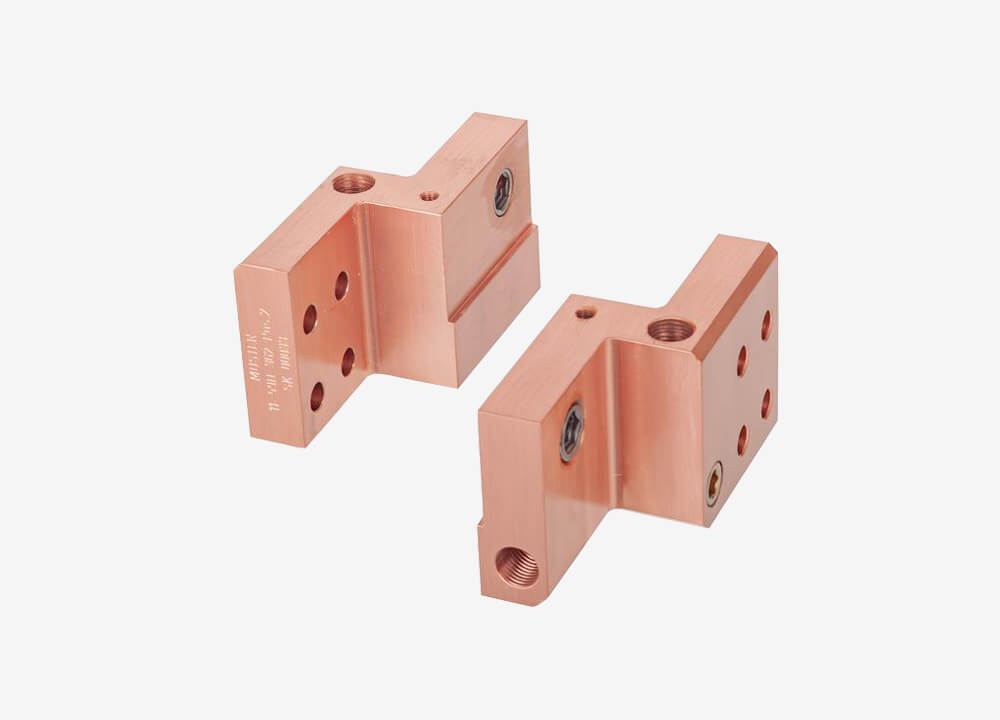


















For a conductive copper component, tell Aria which faces make electrical or thermal contact and which dimensions locate the assembly. We help you discuss the material grade, finish and inspection requirements together. Identify any surfaces that must remain uncoated so the finished part is specified as clearly as the machined shape.
| Property | Details |
|---|---|
| Colors | Reddish metallic |
| Special properties | Oxygen-free grades such as C10100/C10200 and free-machining tellurium copper C14500 are separate options. C14500 trades some conductivity for improved machinability. |
Detailed values describe C11000 copper, H02 half-hard; C11000 copper, conductivity reference. Family ranges are broader selection references and may include different grades or reinforcement levels. Confirm the selected grade, condition and test method for your part. Melting temperature is not a working-temperature limit; use the mill certificate for the specified alloy and temper.
| Property | Metric | Imperial | Test method / conditions |
|---|---|---|---|
| Density | 8.9 g/cm³ | 0.322 lb/in³ | Reference: C11000 copper, H02 half-hard |
| Tensile Strength UTS | 290 MPa | 41,000 psi | ASTM B187 · H02 half-hard (annealed: approximately 220) · Reference: C11000 copper, H02 half-hard |
| Yield Strength | 260 MPa | 38,000 psi | ASTM B187 · H02 half-hard · Reference: C11000 copper, H02 half-hard |
| Elongation | 14 % | 14 % | ASTM B187 · H02 (annealed: approximately 50) · Reference: C11000 copper, H02 half-hard |
| Hardness | 83 HRF - | 83 HRF - | H02 · Reference: C11000 copper, H02 half-hard |
| Elastic Modulus | 120 GPa | 17×10⁶ psi | Reference: C11000 copper, H02 half-hard |
| Thermal Conductivity | 390 W/m·K | 225 BTU/h·ft·°F | Room temperature · Reference: C11000 copper, conductivity reference |
| Electrical Conductivity | 100 % IACS | 100 % IACS | Reference · Reference: C11000 copper, conductivity reference |
| CTE | 17 µm/m·K | 9.4 µin/in·°F | Reference: C11000 copper, H02 half-hard |
| Specific Heat | 390 J/kg·K | 0.092 BTU/lb·°F | Reference: C11000 copper, H02 half-hard |
| Melting Range | 1070~1080 °C | 1950~1980 °F | Solidus–liquidus · Reference: C11000 copper, H02 half-hard |
| Machinability | 20 % reference | 20 % reference | Relative to C36000 · Reference: C11000 copper, conductivity reference |
| Property | Family reference |
|---|---|
| Material class | Copper / copper alloy |
| Density (g/cm³) | 8.9–9.0 |
| Tensile strength (MPa) | 200–360 |
| Elongation at break (%) | 4–50 |
| Elastic modulus (GPa) | 110–130 |
| Hardness | HRF 40–90 |
| Temperature reference (°C) | Melting point ~1080 |
| Standard or designation | Scope and selection notes |
|---|---|
| ASTM B187 / B187M | Copper bus bar, rod and shapes. |
| ASTM B152 / B152M | Copper sheet, strip, plate and rolled bar. |
| ETP copper designation references | UNS C11000; EN CW004A (Cu-ETP); GB T2. Confirm chemistry, conductivity, form and temper before substitution. |
| Before ordering | Grade names listed for comparison are not a blanket equivalence declaration. Agree the product standard, edition, delivery condition and required certificate before approving a substitution. |
CNC Milling Services: CNC turning and milling with sharp, high-rake tools and adequate coolant; drilling and tapping with careful deburring. Consider tellurium copper for demanding production machining. Control burrs and oxidation. Welding or brazing needs a process suited to rapid heat conduction; specify temper rather than assuming all C11000 values are identical. 3-axis milling, 4-axis milling, 5-axis milling: Use a machinable stock grade; geometry, workholding and material condition determine feasibility.
Select the copper grade and temper for cutting, bending and finishing.
CNC Milling Services, CNC turning: CNC turning and milling with sharp, high-rake tools and adequate coolant; drilling and tapping with careful deburring. Consider tellurium copper for demanding production machining. Control burrs and oxidation. Welding or brazing needs a process suited to rapid heat conduction; specify temper rather than assuming all C11000 values are identical. 3-axis milling, 4-axis milling, 5-axis milling, Cylindrical Turning, Boring, Threading, Grooving: Use a machinable stock grade; geometry, workholding and material condition determine feasibility. Wire EDM, Sinker EDM, EDM hole drilling: The workpiece must be electrically conductive. Confirm electrode access and any surface removal after EDM.
CNC turning: CNC turning and milling with sharp, high-rake tools and adequate coolant; drilling and tapping with careful deburring. Consider tellurium copper for demanding production machining. Control burrs and oxidation. Welding or brazing needs a process suited to rapid heat conduction; specify temper rather than assuming all C11000 values are identical. Cylindrical Turning, Boring, Threading, Grooving: Use a machinable stock grade; geometry, workholding and material condition determine feasibility.
The workpiece must be electrically conductive. Confirm electrode access and any surface removal after EDM.
High conductivity, ductility and corrosion resistance, with useful brazing, welding and plating behavior. C11000 is referenced to 100% IACS conductivity.
Low strength and difficult machining: soft copper can stick to tools, form burrs and resist chip breaking. Surfaces oxidize and discolor.
Compare materials for the loads, temperature and environment your part will face.
We review tool access, geometry and material choice before manufacturing.
Dimensional checks and inspection reports for the critical features on your drawing.
Consider tellurium copper for demanding production machining. Control burrs and oxidation. Welding or brazing needs a process suited to rapid heat conduction; specify temper rather than assuming all C11000 values are identical. Polishing, blasting, nickel/tin/silver plating, anti-tarnish treatment and clear lacquer.
Select preparation and coating system for the alloy, surface condition and functional requirements.
Busbars, electrodes, heat-transfer components, terminals, RF/vacuum components and decorative parts.
CNC turning and milling with sharp, high-rake tools and adequate coolant; drilling and tapping with careful deburring.
Polishing, blasting, nickel/tin/silver plating, anti-tarnish treatment and clear lacquer.
Consider tellurium copper for demanding production machining. Control burrs and oxidation. Welding or brazing needs a process suited to rapid heat conduction; specify temper rather than assuming all C11000 values are identical.
Natural reddish metallic color. Polished or blasted surfaces. Nickel, tin or silver plating; protective clear lacquer.
C14500 tellurium copper improves machinability while retaining high electrical conductivity. Copper Development Association data give a typical conductivity of 93% IACS at 68°F (20°C), compared with about 101% IACS for C11000. Confirm the specified temper and supplier certificate when conductivity is a design requirement; these are alloy reference values rather than guaranteed values for every supplied part.
Upload your CAD files and tell us the material and quantity you need.
Talk to an engineer