
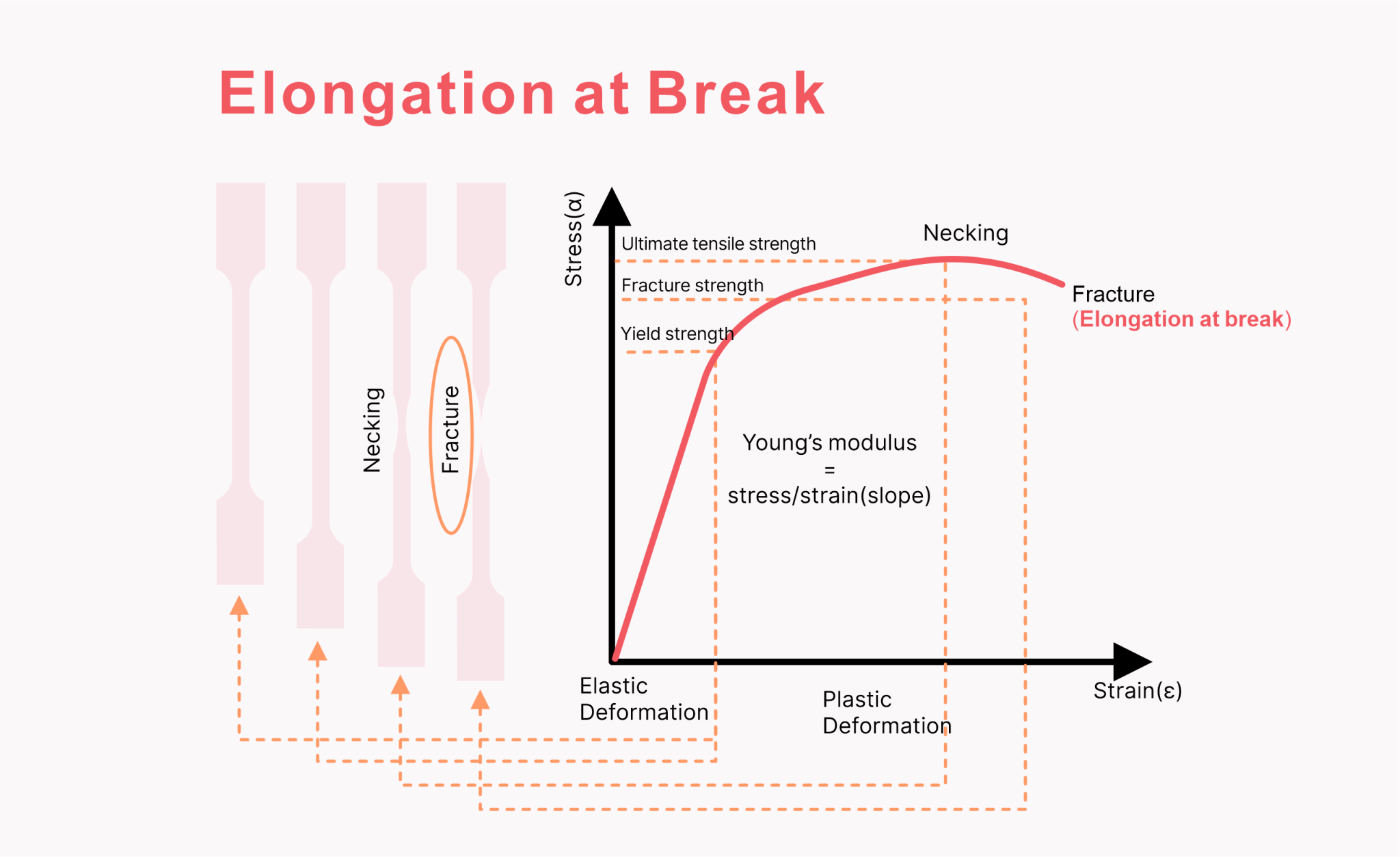
In the field of materials science, elongation at break is a crucial performance indicator, it can directly reflect the deformation capacity and toughness of the material during the tensile process, whether it is for the development of new materials, or to evaluate the applicability of existing materials in different working conditions, elongation at break provides a key quantitative basis, let us in-depth understanding of this key indicator.
What is Elongation at Break?
Elongation at break is the ratio of the amount of elongation to the original length of the material when stretched to break, expressed as a percentage. It is an important indicator to characterize the soft properties, elastic properties and ductility of the material. The larger the elongation at break, the better the softness, elasticity and ductility of the material, and the relatively strong impact resistance.
Elongation at Break Formula
The formula of elongation at break is:
Elongation at break = (final length - original length)/original length x 100%
The following steps can be used to determine the elongation at break of a material:
Measure the original length of the standard distance section of a standard tensile specimen.
Tensile tests are carried out according to standard methods.
At the end of the test, the final length of the gauge section is measured after the specimen has broken.
Subtract the original length from the final length to obtain the length change.
Divide the length change by the original length, then multiply by 100% to get the total elongation percentage.
For Example
The following example, using an aluminum sample, illustrates how to determine elongation at a break:
Measure the original length and diameter of the aluminum sample. Assume the original length was 50 mm.
To determine the length of fracture of an aluminum sample, apply tension to it until it breaks. Consider that the sample is broken at a length of 75 mm.
Calculate the change in sample length:
Length change = Final length - original length
Length variation = 75mm - 50mm
Length change = 25 mm
Elongation at break = (length change/original length) x 100%
Elongation at break = (25 mm / 50 mm) x 100%
Elongation at break = 50%
Materials that are often tested for elongation at break
1. Steel
In order to determine the material properties required for design and quality control purposes, mechanical testing, including tensile testing (to assess elongation at break), is required.
In order to ensure the safety and reliability of the finished product, it is necessary to fully control the metal characteristics and skilled connection technology. Generally speaking, the elongation at break of various steel alloys is in the range of 10-20%.
2. Textiles
Natural fibers such as cotton, wool and silk, as well as synthetic fibers such as polyester, nylon and rayon, are used to make textiles. Each fiber has specific properties that affect the elongation at break of the finished textile material. The elongation at break of cotton fibers is usually between 4-8%.
It is significantly smaller than wool fiber, which typically has a elongation at break of between 25% and 45%. Similarly, the elongation of polyester fiber is significantly higher than that of cotton, more than 50%.
3.Metal
The elongation at break test results of metals can be affected by many variables, including temperature, composition, and cold working. The ductility and toughness of metals, as well as other mechanical properties, are affected by changes in temperature.
The composition of the metal, such as the presence of alloying elements, may also have an effect on its elongation at break value. The strength of the metal can be improved by cold working processes such as rolling or forging, but this also reduces the ductility and elongation at break of the metal. The elongation at break of typical aluminum alloy and pure copper is 17% and 60% respectively.
4. Polymers
Both synthetic and natural polymer materials have long chains of molecules composed of repeating units. PVC, polystyrene, Teflon ™, and polyethylene are some examples of polymers. When performing elongation at break tests, the large plastic deformation that can occur during stretching is usually handled by carefully controlling the test conditions, such as loading rate and temperature. In addition, the sample is designed to have a specific shape and size, such as a dog bone shape, to ensure consistency and repeatability of the results.
The deformation and failure behavior of materials can also be characterized using techniques such as stress-strain curves and fracture mechanics analysis. In general, however, this property is determined by subjecting the material to a certain amount of tensile stress until it reaches its breaking point. Rigid polyvinyl chloride (PVC) has a elongation at break of 25-58%, compared to 1-70% for polystyrene, 40-650% for Teflon ™, and 300-900% for polyethylene.
5. Rubber Material
Rubber is known for its considerable ability to stretch before it breaks. Some elastomers stretch better than others. For example, natural rubber can stretch up to 700% before breaking at maximum elongation. On the other hand, the elongation of fluorine rubber is limited to 300%. The two main types of rubber materials are natural rubber and synthetic rubber.
Both types of rubber materials are tested for elongation at break because it is a key mechanical property that determines whether a rubber material is suitable for a particular application. The test procedure is formed by clamping the rubber material sample at two points and then applying tension until the sample breaks.
Test method for calculating elongation
Test equipment preparation:
As electronic tensile testing machine and other equipment in line with national standards, and ensure its measurement accuracy and stability.
Sample preparation:
Samples of standard size are cut from the material, such as rectangular samples with a length of 200mm and a width of 15mm are often taken to stretch the winding film, and the surface of the sample must be smooth, without damage and pollution.
Test steps:
The sample is fixed on the fixture of the testing machine, the appropriate tensile speed is set, the testing machine is started to stretch, when the sample reaches the breaking point, record the tensile length and other data at the time of breaking, and then calculate the elongation at break according to the formula, usually each sample should be tested at least three times, and the average value is taken as the final result.
Follow the test standards:
- ISO 527-½ - Plastics: Determination of Tensile Properties
- ASTM D882 - Standard Test Method for the Tensile Properties of Thin Plastic Sheeting
- ISO 37:2017 - Rubber, Vulcanized, or Thermoplastic - Determination of Tensile Stress-Strain Properties
- ASTM D638 - Standard Test Method for Tensile Properties of Plastics
Calculate and use the benefits of Elongation at Break
Improve the flexibility of the finished product
Greater design freedom
Enhanced durability and toughness
Reduced risk of breakage
Improve impact resistance
Elongation at break table of various plastics
| Polymer Name | Min Value (%) | Max Value (%) |
| ABS - Acrylonitrile Butadiene Styrene | 10.0 | 50.0 |
| ABS Flame Retardant | 2.0 | 80.0 |
| ABS High Heat | 2.0 | 100.0 |
| ABS High Impact | 2.0 | 100.0 |
| ABS/PC Blend | 60.0 | 85.0 |
| ABS/PC Blend 20% Glass Fiber | 1.90 | 2.10 |
| ABS/PC Flame Retardant | 50.0 | 90.0 |
| HDPE - High Density Polyethylene | 500.00 | 700.00 |
| HIPS - High Impact Polystyrene | 10.00 | 65.00 |
| HIPS Flame Retardant V0 | 10.00 | 50.00 |
| LCP - Liquid Crystal Polymer | 1.00 | 3.00 |
| LCP Carbon Fiber-reinforced | 1.00 | 1.00 |
| LCP Glass Fiber-reinforced | 1.00 | 3.00 |
| LCP Mineral-filled | 2.00 | 5.50 |
| LDPE - Low Density Polyethylene | 200.00 | 600.00 |
| PA 11 - (Polyamide 11) 30% Glass fiber reinforced | 3.00 | 6.00 |
| PA 11, Conductive | 186.00 | 186.00 |
| PA 11, Flexible | 225.00 | 405.00 |
| PA 11, Rigid | 225.00 | 355.0 |
| PA 12 (Polyamide 12), Conductive | 186.00 | 186.00 |
| PA 12, Fiber-reinforced | 4.00 | 8.00 |
| PA 12, Flexible | 300.00 | 340.00 |
| PA 12, Glass Filled | 30.00 | 40.00 |
| PA 12, Rigid | 250.00 | 390.00 |
| PA 6 - Polyamide 6 | 200.00 | 300.00 |
| PA 66 - Polyamide 6-6 | 150.00 | 300.00 |
| PA 66, 30% Glass Fiber | 2.00 | 2.20 |
| PA 66, 30% Mineral filled | 2.00 | 45.00 |
| PA 66, Impact Modified | 150.00 | 300.00 |
| PAI - Polyamide-Imide | 3.00 | 15.00 |
| PAI, 30% Glass Fiber | 6.00 | 7.00 |
| PAI, Low Friction | 7.00 | 9.00 |
| PBT - Polybutylene Terephthalate | 5.00 | 300.00 |
| PBT, 30% Glass Fiber | 2.00 | 3.00 |
| PC (Polycarbonate) 20-40% Glass Fiber | 2.00 | 4.00 |
| PC - Polycarbonate, high heat | 50.00 | 120.00 |
| PC/PBT blend, Glass Filled | 2.00 | 4.00 |
| PE - Polyethylene 30% Glass Fiber | 1.500 | 1.500 |
| PEEK - Polyetheretherketone | 30.00 | 150.00 |
| PEEK 30% Carbon Fiber-reinforced | 1.00 | 3.00 |
| PEEK 30% Glass Fiber-reinforced | 2.00 | 3.00 |
| PEI - Polyetherimide | 59.00 | 60.00 |
| PEI, 30% Glass Fiber-reinforced | 3.00 | 3.00 |
| PEI, Mineral Filled | 6.00 | 6.00 |
| PET - Polyethylene Terephthalate | 30.00 | 70.00 |
| PET, 30% Glass Fiber-reinforced | 2.00 | 7.00 |
| PLA - Polylactide | 5.00 | 7.00 |
| PLA, High Heat Films | 179.00 | 181.00 |
| PLA,injection molding | 2.00 | 3.00 |
| PMMA (Acrylic) High Heat | 2.00 | 10.00 |
| POM - Polyoxymethylene (Acetal) | 15.00 | 75.00 |
| POM (Acetal) Impact Modified | 60.00 | 200.00 |
| POM (Acetal) Low Friction | 10.00 | 70.00 |
| PP - Polypropylene 10-20% Glass Fiber | 3.00 | 4.00 |
| PP, 10-40% Mineral Filled | 30.00 | 50.00 |
| PP, 30-40% Glass Fiber-reinforced | 2.00 | 3.00 |
| PP (Polypropylene) Copolymer | 200.00 | 200.00 |
| PP (Polypropylene) Homopolymer | 150.00 | 60.00 |
| PP, Impact Modified | 200.00 | 700.00 |
| PPA - Polyphthalamide | 2.60 | 30.00 |
| PPA – 30% Mineral-filled | 1.10 | 1.30 |
| PPA, 33% Glass Fiber-reinforced | 2.00 | 2.20 |
| PPA, 45% Glass Fiber-reinforced | 227.00 | 229.00 |
| PPE, Flame Retardant | 30.00 | 50.00 |
| PPE, Impact Modified | 40.00 | 60.00 |
| PPS - Polyphenylene Sulfide | 1.00 | 4.00 |
| PPS, 20-30% Glass Fiber-reinforced | 1.00 | 2.00 |
| PS (Polystyrene) 30% glass fiber | 1.00 | 1.50 |
| PS (Polystyrene) Crystal | 1.00 | 4.00 |
| PS, High Heat | 1.00 | 1.00 |
| PSU - Polysulfone | 50.00 | 100.00 |
| PSU, 30% Glass fiber-reinforced | 2.00 | 3.00 |
| PTFE - Polytetrafluoroethylene | 200.00 | 400.00 |
| PTFE, 25% Glass Fiber-reinforced | 100.00 | 300.00 |
| PVC, Plasticized | 100.00 | 400.00 |
| PVC, Plasticized Filled | 200.00 | 500.00 |
| PVC Rigid | 25.00 | 80.00 |