Every type of plastic shrinks as it cools from molten to solid. If that contraction isn't accounted for, the finished part won't meet its dimensional specs. Here's what drives shrinkage and how to control it.
What Is Plastic Shrinkage?
Plastic shrinkage is the dimensional reduction that occurs as a molded part cools from processing temperature to room temperature. As polymer chains solidify, they pack more closely together, causing the part to contract.
Shrinkage is expressed in in/in or as a percentage. Typical rates range from 0.001 to 0.020 in/in, averaging around 0.006 in/in. Uncontrolled, it leads to warpage, dimensional inaccuracies, and assembly failures.
Factors That Affect Plastic Shrinkage
Material Type and Crystallinity
Semi-crystalline polymers (PP, PE, POM, PBT, PA) shrink more than amorphous ones (ABS, PC, PS, PMMA). When they cool, molecular chains re-arrange into ordered structures that occupy less space. Crystallinity has the largest single influence on shrinkage rate.
Fillers and Reinforcements
Glass fibers and mineral fillers restrain polymer shrinkage. Shrinkage parallel to fiber orientation decreases; transverse shrinkage increases. For inorganic fillers, effectiveness follows: flakes > needles > particles > spherical.
Wall Thickness
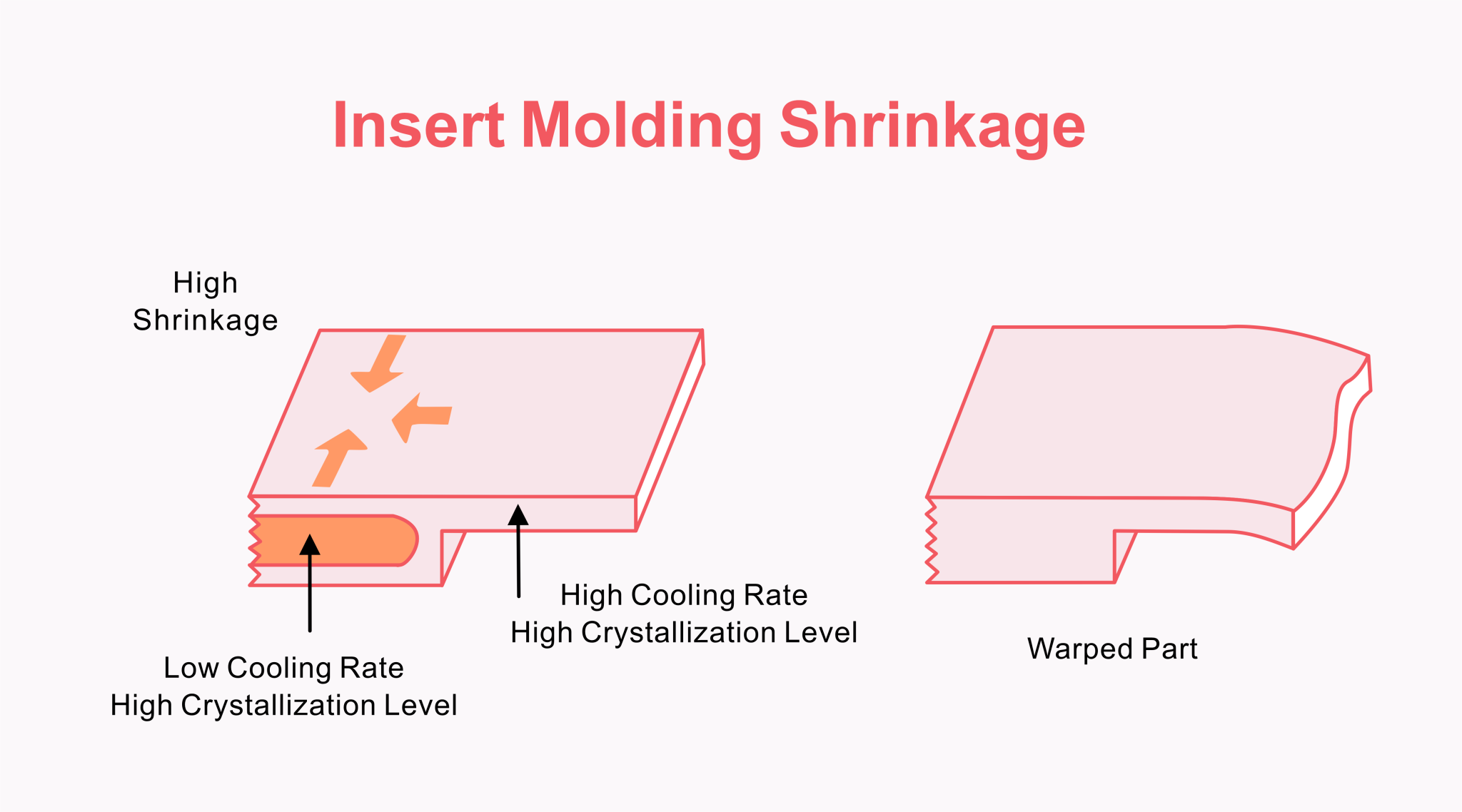
Thicker walls cool more slowly and shrink more. Uneven wall thickness creates differential cooling across the part, which is the primary cause of warpage.
Process Parameters
- Holding pressure and time— insufficient holding causes early gate freeze-off, increasing sink
- Mold temperature— higher mold temperature slows cooling and reduces shrinkage variation
- Cooling rate— faster cooling increases dimensional anisotropy in semi-crystalline materials
- Gate type and location— gate position controls flow direction and where shrinkage concentrates
Part Geometry
Ribs, bosses, and engravings resist shrinkage locally. Metal inserts inside the part further disrupt uniform contraction.
Shrinkage Rates of Common Plastics
The table below lists typical shrinkage ranges based on ASTM D955. Actual rates depend on wall thickness, gate location, mold temperature, and packing pressure.
| Material |
Shrinkage Rate |
Type |
| ABS |
0.4–0.7% |
Amorphous |
| PC |
0.5–0.7% |
Amorphous |
| PMMA |
0.2–0.8% |
Amorphous |
| PS |
0.3–0.6% |
Amorphous |
| PP |
1.0–2.5% |
Semi-crystalline |
| HDPE |
1.5–4.0% |
Semi-crystalline |
| LDPE |
Up to 5.0% |
Semi-crystalline |
| POM (Delrin) |
1.9–2.3% |
Semi-crystalline |
| PA6 / PA66 (unfilled) |
0.8–2.0% |
Semi-crystalline |
| PA6 / PA66 (GF30) |
0.3–0.6% |
Glass-filled |
| PBT |
1.5–2.2% |
Semi-crystalline |
| PPS (GF40) |
0.2% |
Glass-filled (lowest) |
| Fluoroplastics (PTFE) |
Up to 6.0% |
Highest |
Standard test methods: ASTM D955 for thermoplastics; ISO 294-4 for injection-molded specimens.
How to Minimize Plastic Shrinkage
Material Selection
Uniform wall thickness, a well-placed gate, and a balanced cooling system are the three most impactful design decisions. Gate from thick to thin sections to ensure efficient packing.
Mold Design
Apply sufficient holding pressure and time. Control mold temperature consistently. Avoid excessive injection speed, which causes localized shrinkage variation.
Process Parameters
Apply sufficient holding pressure and time to compensate for material contraction. Control mold temperature consistently across the cavity. Avoid excessive injection speed, which can cause localized shrinkage variation.
Mold Cavity Compensation
Scale the mold cavity to offset expected shrinkage:
S = (D − M) / D × 100%. S = shrinkage rate, D = mold cavity dimension, M = target part dimension. Compensation formula:
D = M + MS.
At Aria, cavity compensation is applied during the mold build phase so that cooled part dimensions align directly with the CAD model.
Conclusion
Run shrinkage and warpage simulation before cutting steel. Tools like Moldflow predict how material, geometry, and process settings interact—eliminating guesswork before the first tool cut.
If you're preparing a part for injection molding and want to discuss shrinkage compensation for your material and geometry,
contact Aria's engineering team.

Written By
Custom Quality Parts By Aria
Send your specs. We’ll get back with a quote in 12 hours.
Request Quote